
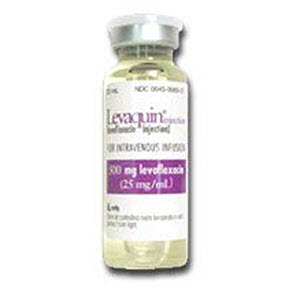
Common Uses: This medicine is a fluoroquinolone antibiotic used to treat bacterial infections (e.g., urinary tract infections, skin infections, or respiratory tract infections).
Generic Name: E: LEVOFLOXACIN (lee-voe-FLOX-a-sin)
[Levaquin]. Medications should only be taken in accordance with the advice of your medical professional.
Buy
Drugs Online Without Prescription - Click Here!
More about Levaquin :
How to use this Medicine: Use this medicine exactly as directed by your doctor. This medicine may be taken on an empty stomach or with food. TAKE THIS MEDICINE WITH A FULL GLASS (8 ounces) OF WATER. Also, drink several additional glasses of water each day. TAKE THIS MEDICINE 2 hours before or 2 hours after taking any medicines containing magnesium or aluminum. Some examples include quinapril, didanosine, vitamins/minerals, and antacids. Sucralfate, bismuth subsalicylate, iron, and zinc are also included. These medicines bind with levofloxacin preventing its full absorption. STORE THIS MEDICINE at room temperature between 59 and 86 degrees F (15 and 30 degrees C) in a tightly-closed container, away from heat and light. Do not store in the bathroom. TO CLEAR UP YOUR INFECTION COMPLETELY, continue taking this medicine for the full course of treatment even if you feel better in a few days. Do not miss any doses. IF YOU MISS A DOSE OF THIS MEDICINE, take it as soon as possible. If it is almost time for your next dose, skip the missed dose and go back to your regular dosing schedule. Do NOT take 2 doses at once.
Mexican name is Elequine
Cautions: DO NOT TAKE THIS MEDICINE IF YOU HAVE HAD A SEVERE ALLERGIC REACTION to this medicine or another fluoroquinolone antibiotic (such as ciprofloxacin, ofloxacin). A severe reaction includes a severe rash, hives, breathing difficulties, or dizziness. If you have a question about whether you are allergic to this medicine or if a certain medicine is a fluoroquinolone, contact your doctor or pharmacist. IF THIS MEDICINE CAUSES A SKIN RASH, HIVES, OR DIFFICULTY BREATHING, check with your doctor before taking additional doses. If your symptoms do not improve or if they become worse, check with your doctor. KEEP ALL DOCTOR AND LABORATORY APPOINTMENTS while you are using this medicine. THIS MEDICINE MAY CAUSE DIZZINESS or lightheadedness. Using this medicine alone, with other medicines, or with alcohol may lessen your ability to drive or to perform other potentially dangerous tasks. Ask your doctor or pharmacist if you have questions about which medicines cause dizziness. IF MODERATE TO SEVERE DIARRHEA OCCURS during or after treatment with this medicine, check with your doctor or pharmacist. Do not treat it with non-prescription (over-the-counter) medicines. THIS MEDICINE MAY CAUSE increased sensitivity to the sun. Avoid exposure to the sun, sunlamps, or tanning booths until you know how you react to this medicine. Use a sunscreen or protective clothing if you must be outside for a prolonged period. BEFORE YOU BEGIN TAKING ANY NEW MEDICINE, either prescription or over-the-counter, check with your doctor or pharmacist. FOR WOMEN: IF YOU PLAN ON BECOMING PREGNANT, discuss with your doctor the benefits and risks of using this medicine during pregnancy. BASED ON INFORMATION FROM A RELATED DRUG, this medicine may be excreted in breast milk. DO NOT BREAST-FEED while taking this medicine. IF YOU HAVE DIABETES, this medicine may affect your blood sugar. Check blood sugar levels closely and ask your doctor before adjusting the dose of your diabetes medicine.
Possible Side Effects: SIDE EFFECTS that may occur while taking this medicine include nausea, trouble sleeping, diarrhea, vomiting, change in taste, headache, or dizziness. If they continue or are bothersome, check with your doctor. CHECK WITH YOUR DOCTOR AS SOON AS POSSIBLE if you experience tendon, joint, or muscle pain or swelling, "sunburn" (sun sensitivity), vaginal discomfort, abdominal pain, or vision changes. CONTACT YOUR DOCTOR IMMEDIATELY if you experience seizures, mental/mood changes, chest pain, irregular heartbeat, restlessness, confusion, change in amount of urine, or yellowing of eyes or skin. Use of this medicine for prolonged or repeated periods may result in oral thrush, or a new yeast infection (e.g., oral or vaginal fungal infection). Contact your doctor if you notice white patches in your mouth, a change in vaginal discharge or other new symptoms. If you notice other effects not listed above, contact your doctor, nurse, or pharmacist.
500 mg 7 tablets

For years, Americans living near Canada and Mexico have taken advantage of the low cost prescription drugs available across the border, allowing them to purchase brand name and generic medicines like Levaquin at
substantial savings compare to prices in the United States. You must only take medications in accordance with the advice of your doctor or medical professional and you must only take prescription drugs if you are in possession of a valid prescription.
[Levaquin]
MedSupport.org makes no endorsements, representations or warranties regarding any services or products offered at any online pharmacies.

< Previous
Next > | Back
to Index

|
|
Drug interactions with over-the-counter
cough medicines : There are two general types of cough medicine that are available
over the counter. (There are also some types of cough medicines with significant
amounts of narcotics like codeine, but these stronger cough medicines are only
available by prescription.) Some over-the counter cough medicines are antitussives.
Dextromethorphan is one of the more common ingredients in antitussives. An antitussive
is a cough suppressant. It works by partially blocking the cough reflex. It
lessens your body’s tendency to allow a cough to be triggered involuntarily.
Some common antitussive over-the-counter cough medicines include Triaminic Cold
and Cough, and Vicks 44 Cough and Cold.
The other type of over-the-counter cough medicine is an expectorant. The main
ingredient for over-the-counter expectorants is guaifenesin. Expectorants work
by thinning the mucus that can clog your airway and cause you to cough to clear
it. Some common expectorant over-the-counter cough medicines include Mucinex
and Robitussin Chest Congestion. With any medication, including fairly tame
over-the-counter medications, you always want to be aware of the risk of it
interacting adversely with some other medication - over-the-counter or prescription
- that you are taking. In the case of over-the-counter cough medicine, the primary
risk is consuming too much of an ingredient because you’re not aware it’s in
multiple medications you’re taking. This happens most often because some products
are designed to treat multiple symptoms of, say, a cold. So you need to read
your labels and check the ingredients.
For instance, you may be taking something you think
of as a cough medicine, when in fact if you look closely you’ll see that it
treats other symptoms as well. Then if you’re also taking something else for
those other symptoms, you could be inadvertently doubling up. You might be taking,
say, an antihistamine, a decongestant, and/or a pain reliever, and if one or
more of these is also contained in your cough medicine, then you may exceed
the recommended dose. Or, your cough medicine may indeed be solely a cough medicine,
but you may be also taking a general cold remedy which itself contains cough
medicine, thus exceeding the recommended dosage in that way. Beyond that, there
is a small risk of an over-the-counter cough medicine interacting adversely
with certain prescription drugs. If you are on any prescription medications,
always ask your doctor before taking cough medicine, or any other medication.
Specifically, some patients taking a monoamine oxidase inhibitor (MAOI), a prescription
drug used to treat depression among other conditions, have had problematic interactions
with over-the-counter cough medicines. |